The Oscillator · Entry 03
Temperature Changes the Length
A steel rod grows in summer and the clock loses. The problem stated plainly.
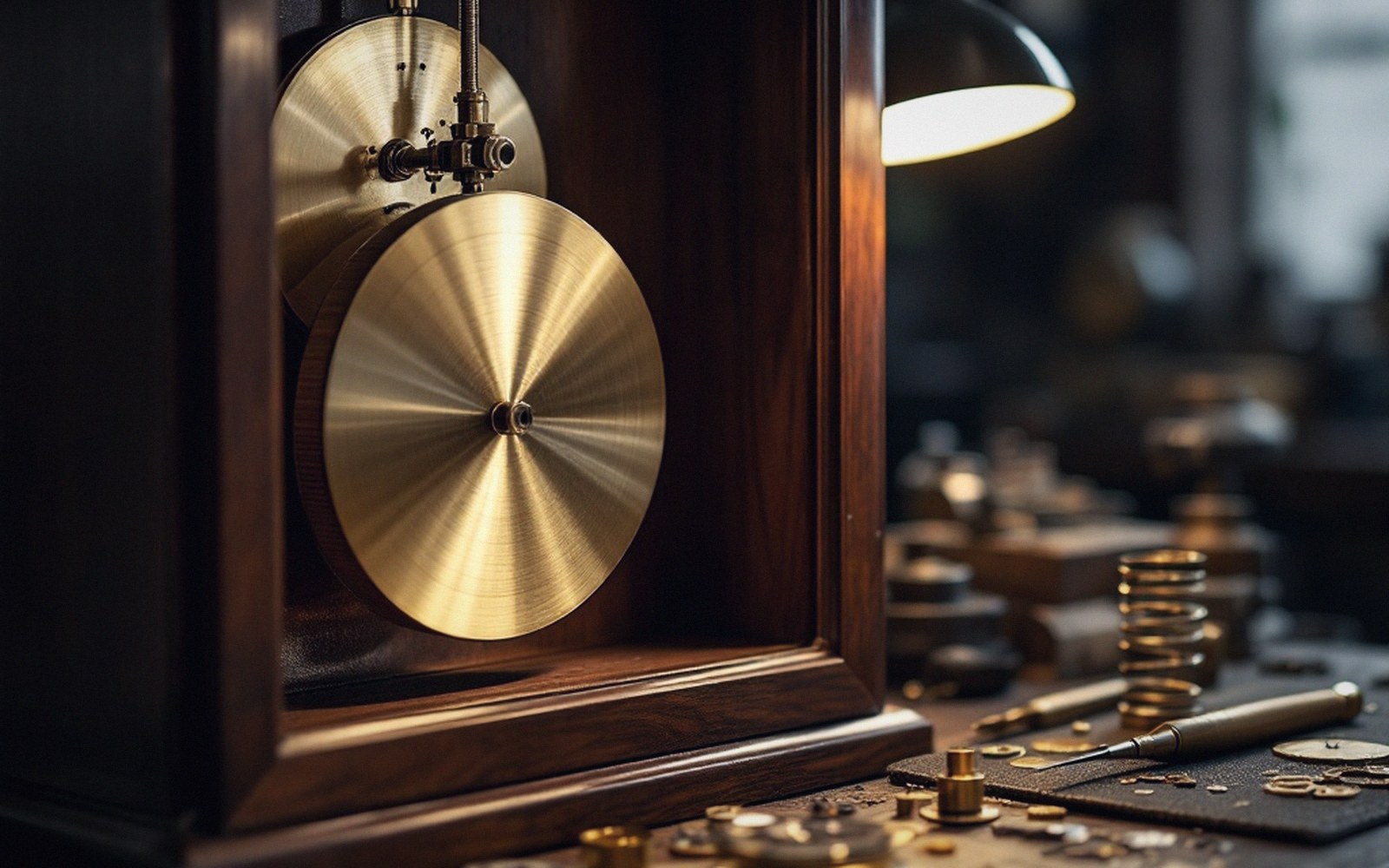
A steel pendulum gets longer when the room warms up — and a longer pendulum swings more slowly. The clock falls behind.
The Numbers Don't Lie
Steel expands by roughly eleven parts per million for every degree Celsius of temperature rise. That sounds vanishingly small until you work through the arithmetic. A seconds-beating pendulum — one that swings once per second — hangs at just under a metre. Raise the temperature of that steel rod by ten degrees and it grows by about 0.11 millimetres. The period of a pendulum depends on the square root of its length divided by gravitational acceleration, which means even a fractional increase in length pushes the period outward. Ten degrees of warming costs a precision clock something in the region of five seconds per day. For a household clock, nobody notices. For an observatory regulator or a clock governing a transit telescope, it is a catastrophe.
The mechanism of the error is worth keeping clear. A longer pendulum has farther to travel at any given amplitude, but the restoring force — gravity — has not changed. The oscillator therefore takes longer to complete each swing. The going train faithfully counts every beat it receives, so it displays time based on whatever period the pendulum is actually running. If that period has drifted, the displayed time drifts too, in perfect lockstep.

Cold works the other way: the rod contracts, the period shortens, and the clock gains. A clock regulated in a cool January workshop runs slow come August unless something corrects for the expansion. The error is not random noise — it tracks the temperature systematically, which at least makes it predictable, even if the pendulum itself offers no self-correction.
Wood fares somewhat better than steel because its thermal expansion along the grain is lower, and some early long-case clock makers exploited this, but wood is hygroscopic: it swells and shrinks with humidity as well, trading one nuisance for another. Zinc, brass, iron and other metals all expand at different rates, a fact that clockmakers eventually turned to advantage by building compound pendulum rods from two or more metals arranged so that their expansions partially cancel. That approach — elegant in principle, demanding in execution — is described in detail in the companion piece on gridiron and mercury compensation. The cleaner modern solution was to find a material that barely expands at all, which happened at the end of the nineteenth century and changed precision timekeeping almost overnight.
From the bench notes
The physics in brief
| Quantity | What it means |
|---|---|
| Seconds-beating pendulum length | just under one metre for a one-second period |
| Thermal expansion of steel | approximately 11 parts per million per degree Celsius |
| Effect of 10 °C rise on a seconds pendulum | roughly 0.11 mm of extra length |
| Consequent rate error | around five seconds per day per 10 °C shift (order-of-magnitude figure) |
| Direction | warming causes loss; cooling causes gain |