The Oscillator · Entry 01
Why a Pendulum Keeps Time
Period depends on length and gravity and almost nothing else — which is the whole reason it works, and also the source of every problem that follows.
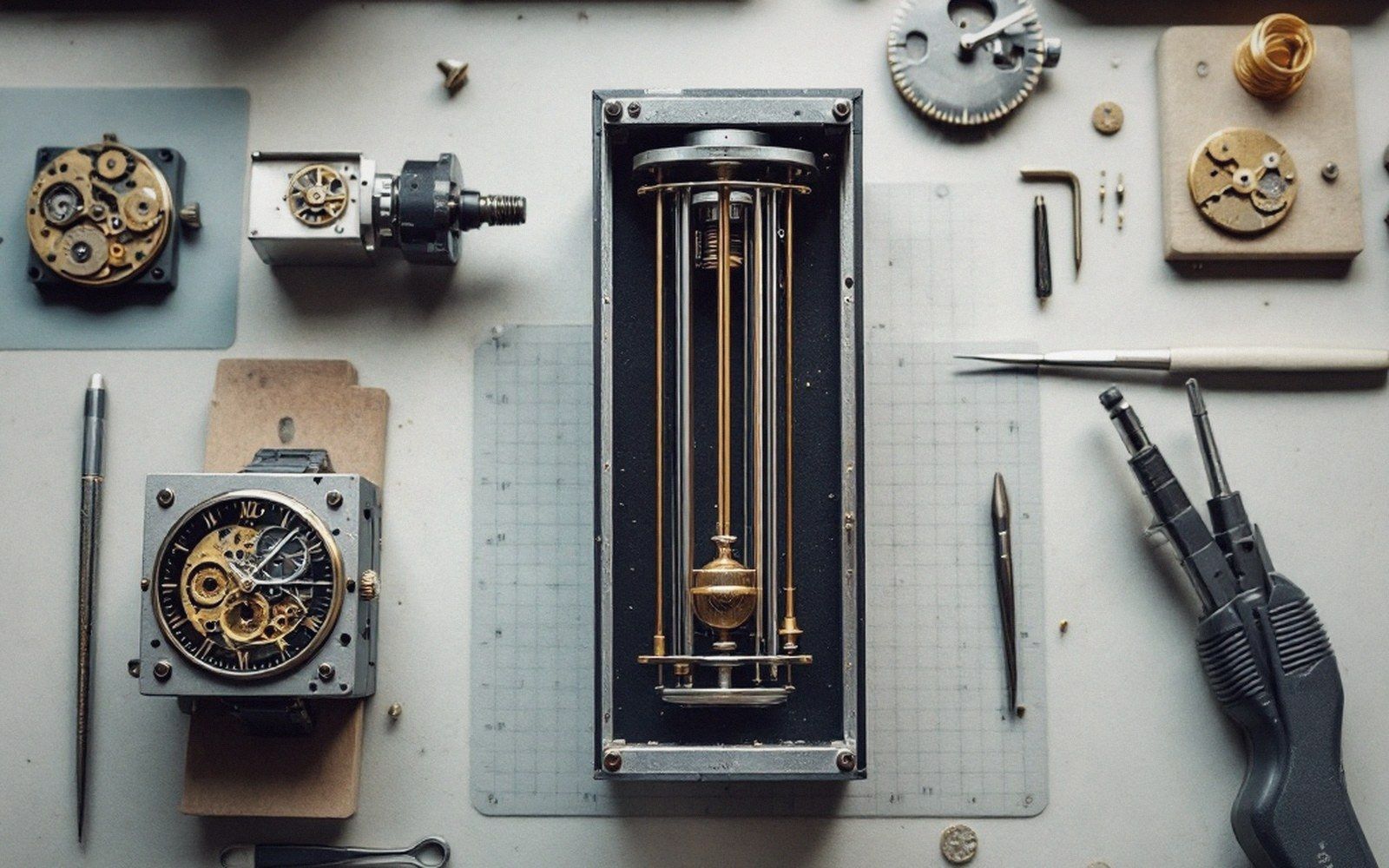
Gravity and length, nearly alone, determine the period. That near-solitude is both the genius and the limitation.
The Geometry of the Swing
A pendulum is a weight on a cord or rod, free to swing about a fixed pivot. What makes it useful as a timekeeper is not that it swings, but that it swings in almost equal time regardless of how far it swings. Galileo observed this property — isochronism — watching a lamp swing in Pisa cathedral, though the legend of the precise timing is almost certainly embellished. What is not embellished is the physics.
For small arcs, the restoring force pulling the bob back toward the bottom is proportional to its displacement from rest. That proportionality is the key: it makes the pendulum a simple harmonic oscillator, and for any such oscillator the period is independent of amplitude. Double the push, and the bob travels twice as far but also moves twice as fast — the two effects cancel, and the period stays the same. This is why a pendulum tolls even time even as friction slowly reduces its swing from beat to beat.
The period of a simple pendulum depends on just two quantities: the length from pivot to the centre of mass of the bob, and the local value of gravitational acceleration. The relationship is clean. A pendulum roughly one metre long — 994 millimetres, to be specific — beats once per second at standard gravity. The Royal Observatory at Greenwich used seconds pendulums close to this length. Make the rod longer and the clock runs slower; shorten it and it gains. This is the entire basis of rate regulation: a small nut at the base of the rod threads up or down to raise or lower the bob by fractions of a millimetre.
Why "Almost" Matters
The isochronism is not perfect. At wider arcs, the proportionality breaks down; the restoring force no longer tracks displacement exactly, and the period begins to lengthen with amplitude. This is circular error, and it is why precision regulators use a very small, carefully controlled swing — one or two degrees at most. The escapement must feed just enough energy to maintain the arc without varying it, since any change in amplitude becomes a change in rate.
There is a second limitation, more insidious: length is not fixed. Every material expands when heated. A steel rod that keeps perfect time on a cold morning runs slightly slow on a warm afternoon, because the bob has descended by a tiny fraction of a millimetre as the metal expanded. The effect is real, measurable and consequential — a seconds pendulum in steel loses roughly half a second per day for each degree Celsius of rise. Temperature changes the length, and that sentence is the entire statement of the problem that occupied horologists from the late seventeenth century until the development of the alloy that solved it.
From the bench notes
Key relationships
| Item | What it means |
|---|---|
| Seconds pendulum length | approximately 994 mm at standard gravity; the canonical length of precision regulator pendulums |
| Rate change with temperature | steel pendulum loses roughly half a second per day per degree Celsius of warming |
| Circular error | period increases at larger amplitudes; why regulators keep swing to one or two degrees |
| Local gravity variation | differs measurably pole-to-equator and with altitude; affects transported regulators |
Gravity, the other variable, also shifts — though more slowly. Local gravitational acceleration differs by fractions of a percent between the equator and the poles, and also varies slightly with altitude. A regulator clock transported from London to a high-altitude observatory will run measurably slow until its pendulum is shortened to compensate. This was not a theoretical curiosity: the rating certificates issued with high-grade precision regulators were valid at specific locations.
Despite these qualifications, the pendulum's dominance of precision timekeeping from Huygens's clock of 1656 until well into the twentieth century rests on exactly what the physics promises: a period governed by quantities that change slowly and predictably, driven by a force — gravity — that is always available, costs nothing, and requires no maintenance. The craftsman's task was to keep everything else from interfering. The escapement, the temperature compensation, the jewelled bearings, the maintaining power — every added mechanism is, in some sense, an apology for the ways the real world refuses to hold still.
From the bench notes
Chronology
- 1656Christiaan Huygens builds the first practical pendulum clock, applying the isochronism principle to horology
- Late 17th century onwardtemperature compensation becomes a recognised engineering problem as regulator-grade accuracy improves
- 20th centuryInvar and then quartz displace the pendulum from the front rank of precision timekeeping