Regulation · Entry 04
Isochronism
The ideal of a period that does not change with amplitude — the property the whole site is named for.
The ideal every mechanical oscillator reaches for: a period that stays constant whatever the amplitude.
The Thing You Are Actually Trying to Guarantee
A clock keeps time because something oscillates — pendulum or balance wheel — and the oscillator's period is treated as a fixed unit. The gear train divides that period into seconds, minutes and hours. If the period wanders, every division it generates wanders with it.
Isochronism is the name for the property where the period stays constant regardless of how wide or narrow the swing is. The Greek roots say it plainly: isos (equal) and chronos (time). An isochronous oscillator takes exactly the same time to complete a small arc as a large one.
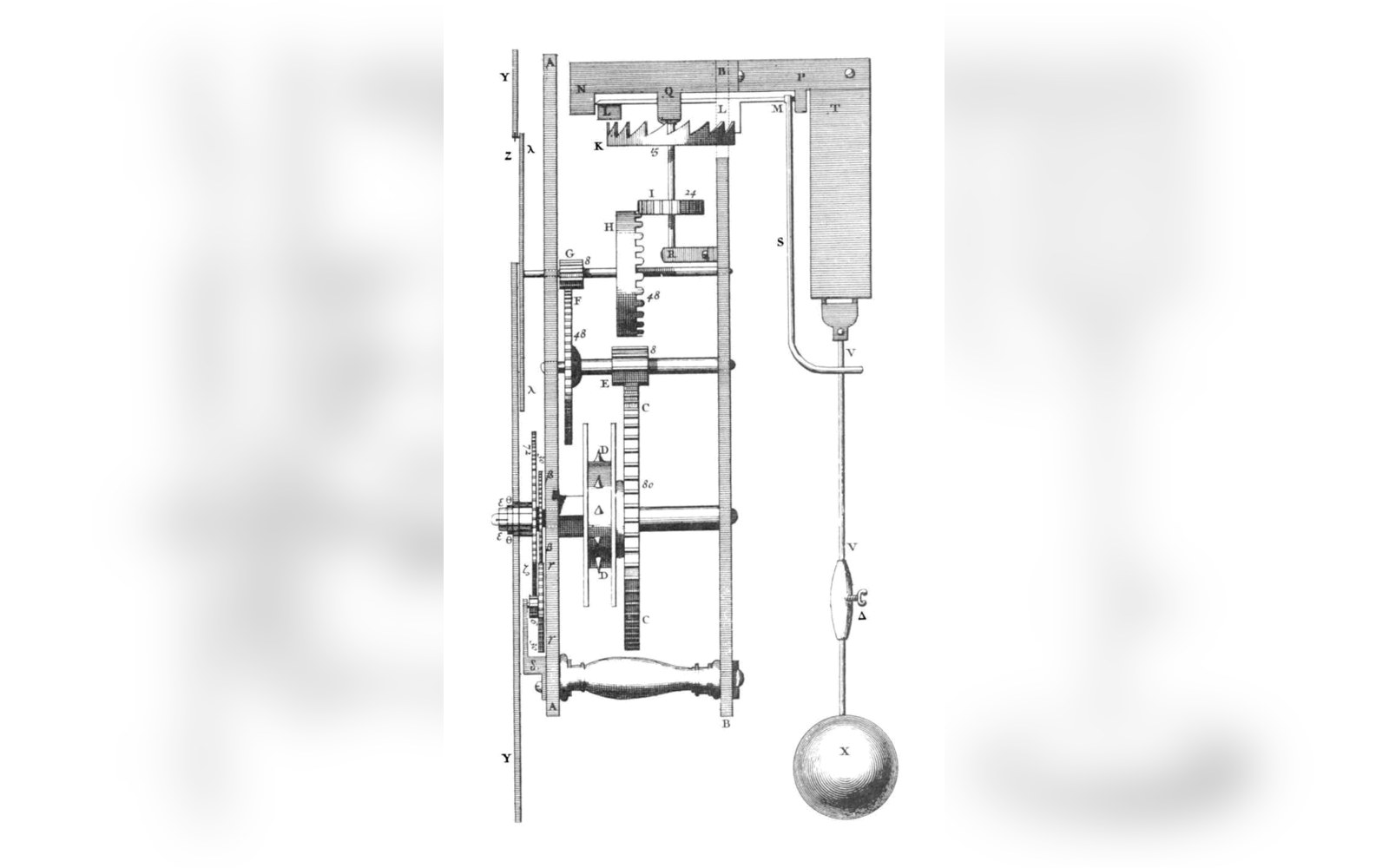
A perfect pendulum swinging through small angles very nearly achieves this, which is why Huygens's clock of 1656 was such a leap. Gravity provides a restoring force proportional to displacement, and at small angles the geometry co-operates closely enough that amplitude changes cause only tiny period changes. But only at small angles. As the arc grows, circular error sets in and the period lengthens. Practical precision regulators keep the pendulum swing deliberately slight to stay inside the range where the approximation holds well.
The balance wheel faces the same problem in a different form. Here the restoring force is the hairspring rather than gravity, and the question is whether the spring produces a force strictly proportional to its deflection across the full working range of the coil. If it does, the balance is isochronous; if the spring is poorly formed, pinned at the wrong point, or deformed by temperature and wear, the period will shift as the amplitude shifts. In a watch this matters acutely: amplitude changes every time the mainspring runs down between windings, and the movement experiences varying positions and shocks throughout the day.
Clock- and watchmakers have pursued isochronism through geometry and material simultaneously. Huygens showed theoretically that a pendulum constrained to swing in a cycloidal arc rather than a circular one would be perfectly isochronous — the cycloidal cheeks he fitted to early pendulum clocks were the practical attempt, though the improvement proved marginal in the range of normal use. For the balance wheel, correct terminal curve geometry on the hairspring's outermost coil is the principal correction available, the form worked out analytically in the nineteenth century and refined on the timing machine ever since.
From the bench notes
The core concept
| Term | What it means |
|---|---|
| Isochronism | Isochronism period unchanged by amplitude; from Greek isos (equal) + chronos (time) |
| Circular error | the deviation from isochronism that grows with pendulum arc |
| Cycloidal cheeks | Huygens's physical device to constrain a pendulum to a cycloidal path, theoretically achieving perfect isochronism |
| Terminal curve | the shaped outer coil of a balance hairspring, correcting the spring's force curve toward isochronism |
The site's name is not incidental. Every mechanism described here — escapement geometry, temperature compensation, going-train design — serves, directly or indirectly, the same goal: keeping the period equal, beat after beat, regardless of what changes around it.

From the bench notes
Chronology
- 1657Huygens patents the pendulum clock; near-isochronous behaviour of the small-angle pendulum is its underlying rationale
- Nineteenth centuryanalytical derivation of correct terminal curve geometry for the balance hairspring