Regulation · Entry 01
What a Timing Trace Is Actually Showing You
Rate, beat error and amplitude read off a microphone and a screen. How each fault looks, and why amplitude is the number that reveals the health of the movement.
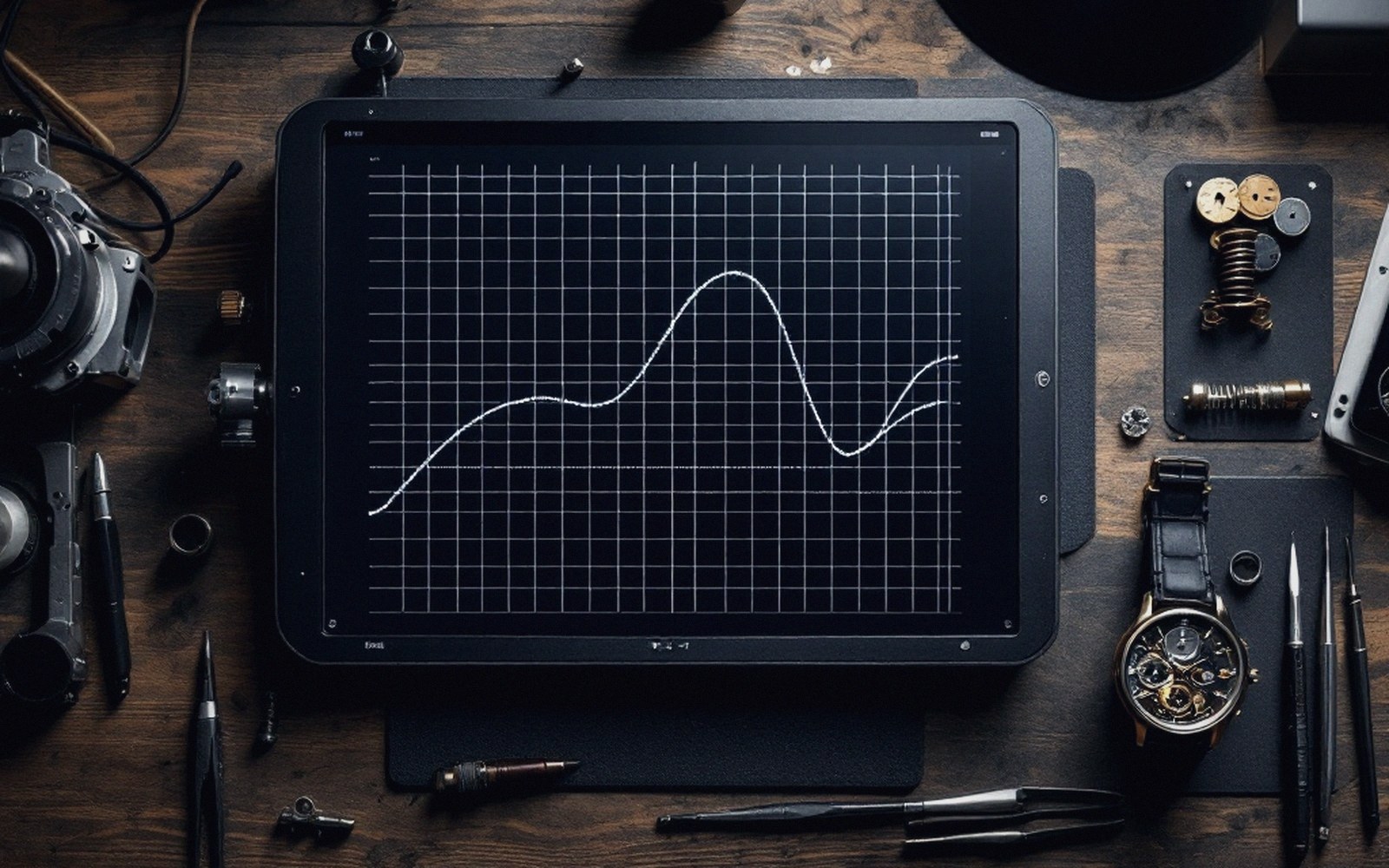
A timing machine turns tick and tock into numbers. Reading those numbers correctly is the whole skill.
What the Trace Records
A timing machine — whether a dedicated instrument like a Witschi or Greiner, or a smartphone app running the same logic — listens through a microphone clipped to the movement. It detects each impulse: the tick and, separately, the tock. From the interval between successive beats it calculates rate, expressed as seconds per day gained or lost. From the difference between the tick interval and the tock interval it calculates beat error. From the energy of each impulse signature it estimates amplitude, the arc through which the balance or pendulum swings on each beat. Three numbers from one microphone, and each one tells you something different.
The printout, or the scrolling line on a screen, maps time horizontally and beat timing vertically. A perfectly regulated movement running in beat produces a straight horizontal line: every beat arrives exactly where it should, and the line neither rises nor falls. What you actually see is almost never that. Learning to read the deviations is the point.

Rate, Beat Error and What Each Looks Like
Rate shows as the slope of the trace. A line tilting upward means the movement is gaining; tilting downward, losing. The steeper the tilt, the faster the drift. A gain of thirty seconds a day is an extreme slope; two seconds a day is barely perceptible. Adjusting the effective length of the hairspring — moving the index, or shifting a timing washer on a regulated balance — changes the slope. When the line runs flat, rate is correct for that position.
Beat error appears as a paired pattern in the trace. The machine plots tick and tock as separate marks; if one interval is longer than the other, those marks split apart into two parallel lines running side by side. A perfectly equal beat produces a single line, or two lines so close they overlap. A large beat error produces a visible gap. The gap does not affect rate directly — a clock can keep good time while badly out of beat — but it increases the mechanical asymmetry at the escapement and wastes energy unevenly. On a lever escapement, significant beat error also increases the risk of setting: a condition where the lever rests against the banking and the movement stops entirely.
Correcting beat error means adjusting the relationship between the lever's rest position and the balance's neutral point. On many movements this means bending the cock slightly, or shifting the collet on the balance staff. It is a mechanical adjustment, not a rate one, and it does not change the slope of the trace.
From the bench notes
What the trace reveals
| Item | What it means |
|---|---|
| Rate | slope of the line; upward means gaining, downward losing, flat means correct |
| Beat error | gap between tick and tock marks; single line is perfect, parallel lines indicate asymmetry |
| Amplitude | energy of each impulse; the figure that reveals friction, oil condition and mechanical health |
Why Amplitude Is the Health Number
Amplitude is the figure most newcomers overlook, and it is the most informative of the three. A lever watch running at full wind should show an amplitude somewhere between 270 and 310 degrees, depending on calibre; a pendulum regulator should swing to its design arc. Amplitude is not directly adjustable — you cannot turn a screw to increase it. It is a consequence of everything else: mainspring tension, pivot friction, oil condition, escapement geometry, and whether the impulse faces are clean. When amplitude is low, something in the energy chain is absorbing what should be reaching the oscillator.
A trace showing low amplitude alongside good rate is a warning. The movement is keeping time for now, but with reduced reserve. Any additional friction — a thickening oil, a worn jewel, a slight rust on a pivot — and it may stop. A trace showing amplitude that collapses as the spring runs down points to a power-delivery problem: fusee wear, a sticky mainspring, or a remontoire that is not resetting cleanly. Amplitude that varies with position, improving in the flat positions and worsening in the vertical positions, points toward pivot friction and the geometry of the balance and its spring.
Reading a timing trace well is reading the movement's energy budget. Rate tells you what to adjust; beat error tells you what to align; amplitude tells you whether the movement is healthy enough for those adjustments to hold.
From the difference between the tick interval and the tock interval it calculates beat error.

From the bench notes