Escapements · Entry 03
Anchor and Recoil
Better, but it pushes the train briefly backwards at every beat. What that costs.
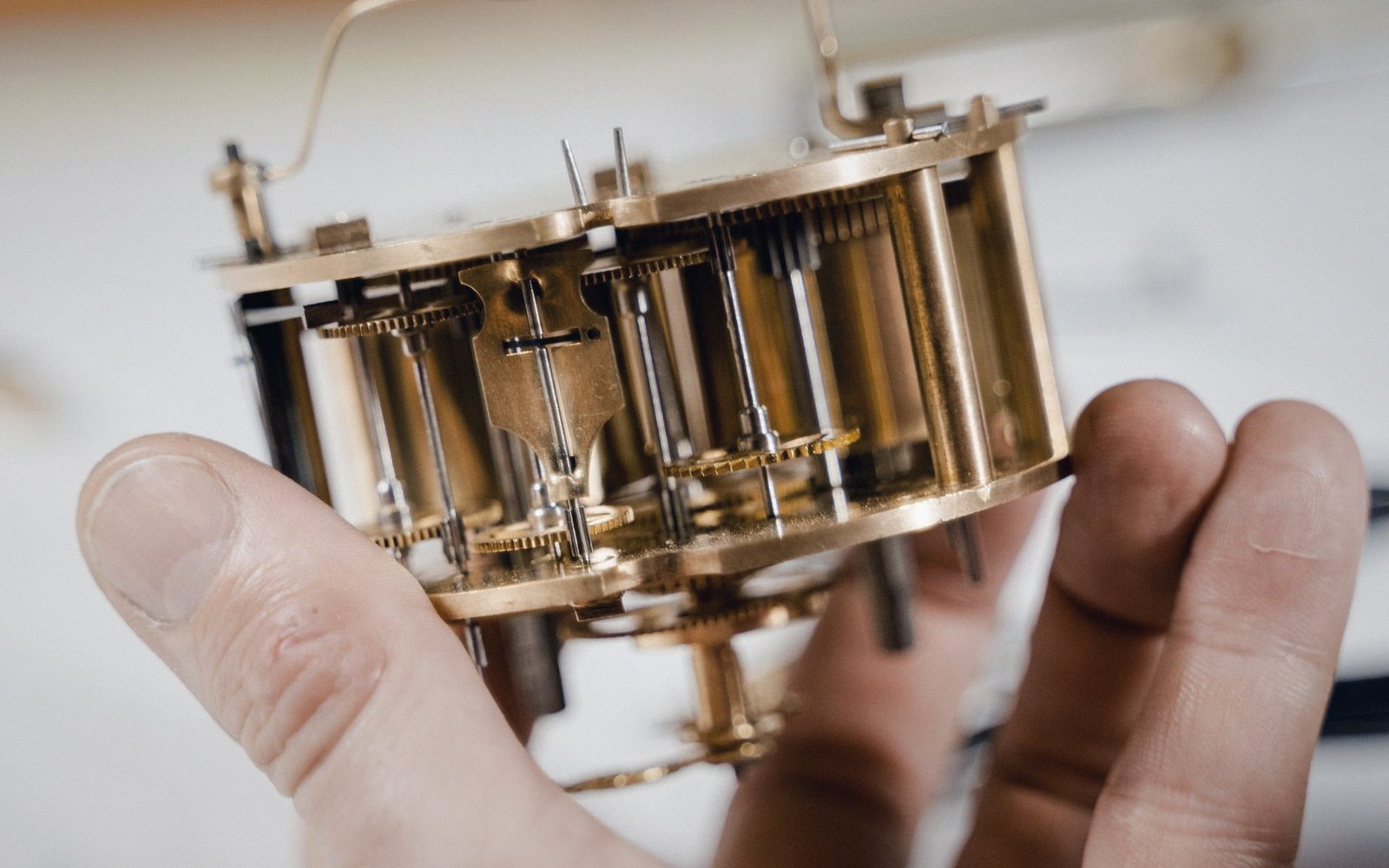
The clock that almost got it right
The anchor escapement — named for the vague resemblance of its pallets to a ship's anchor — was the first serious improvement on the verge. Introduced in England in the 1670s, probably by Robert Hooke or William Clement (the historical record is frustratingly ambiguous), it transformed the pendulum clock from a promising novelty into a practical timekeeper. It also introduced a fault that is baked into its geometry.
The anchor works by letting a toothed escape wheel advance one tooth at a time, each tooth caught and released by angled pallet faces that engage alternately. The geometry is elegant. The pallets straddle only a small arc of the wheel, so the pendulum needs to swing only a few degrees rather than the thirty or more demanded by the verge. Small swings mean smaller circular error — the drift in period that afflicts wide arcs — so the anchor immediately gave clocks an accuracy the verge could never match. Longcase clocks with anchor escapements routinely kept time to within seconds per day rather than minutes.
The problem is the pallet angle. When a tooth hits the locking face of either pallet, the geometry drives the pallet — and the pendulum — back. Simultaneously, that same impulse pushes the escape wheel slightly backwards. Watching from above, the seconds hand on a longcase clock visibly hesitates and retreats a fraction before it steps forward. This is recoil, and it is not merely cosmetic.

Every reversal of the wheel stresses the pivot holes and the tooth flanks. More importantly, it means the wheel is never quite at rest between beats: it rocks, and the energy lost to that rocking is energy that should have been sustaining the pendulum's swing. Lubrication in the escapement, already a weak point in any clock movement, is disturbed by the to-and-fro motion. Over time, the anchor's pivot holes and wheel teeth wear in a characteristically scalloped pattern that a recoilless design does not produce.
For most domestic clocks this is entirely tolerable. The anchor escapement remained standard in longcase and bracket clocks for two centuries and is still used in modern replicas and traditional movements. Its tolerance for minor errors of beat and the ease with which it can be set up kept it far ahead of more demanding alternatives in practical use.
But for an observatory regulator or a precision standard, recoil was disqualifying. The solution — shaping the locking faces as arcs centred on the pallet pivot, so the wheel neither advances nor retreats while locked, simply resting on a curved dead surface — gave the deadbeat escapement, demonstrated by George Graham in 1715. The anchor and the deadbeat share almost every feature except that one angled face, and the difference between them is the difference between a good clock and a serious one.
From the bench notes
How it works
- Anchor escapementpallets shaped like a ship's anchor engage a toothed escape wheel alternately, releasing one tooth per swing of the pendulum
- Recoilat each lock, pallet geometry briefly drives the escape wheel backwards before it advances; visible as a hesitation in the seconds hand
- Swing arcanchor requires only a few degrees of pendulum arc vs. thirty-plus for the verge; smaller swing reduces circular error

From the bench notes
Chronology
- 1670sanchor escapement introduced in England, attributed to Robert Hooke or William Clement (attribution contested)
- 1715George Graham demonstrates the deadbeat, eliminating recoil for precision work