Escapements · Entry 01
Something Must Let the Train Forward in Equal Amounts
The central difficulty of every mechanical timepiece: energy has to reach the oscillator without disturbing it, and the oscillator has to release the train without being pushed off its own rhythm. Every escapement is one answer to that.
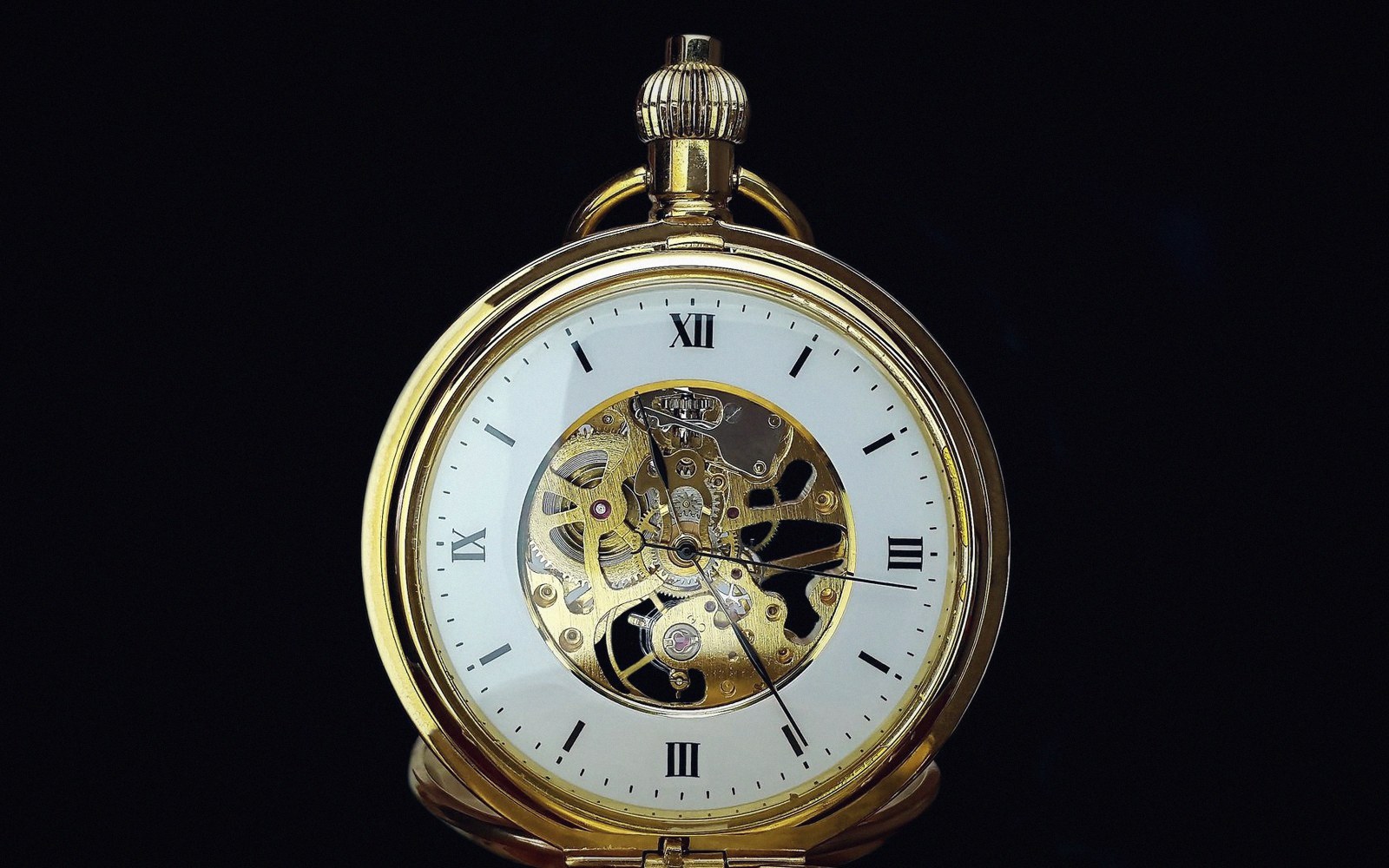
The problem that defines the whole machine
A clock is, at its core, a controlled release. Somewhere inside it a weight descends or a spring unwinds, and that energy must be metered out in portions of exactly equal size. The mechanism that performs that metering is the escapement, and every other part of a clock — the gear train, the pendulum, the balance wheel — exists in service of, or in tension with, what the escapement is trying to do.
The difficulty is structural. You have two things that want to interfere with each other. On one side is the going train: a set of gears under continuous pressure from the motive force, always trying to run forward. On the other is the oscillator — pendulum or balance — whose only virtue is that it swings in equal time regardless of how hard it is pushed. The escapement must connect them. But the moment it connects them, each corrupts the other slightly. The train pushes the oscillator, nudging it off its natural period. The oscillator stops the train, loading it with a jolt it has to absorb at every beat. The designer's whole art is to make that corruption small enough that it does not matter.
Two demands sit in permanent tension. The oscillator must receive just enough energy to keep swinging — no more, because excess energy changes the amplitude, and changing amplitude changes the period. The train must be released in precisely equal angular steps, because any irregularity in those steps becomes an irregularity in rate. An escapement that delivers a large impulse when the mainspring is freshly wound and a small one when it runs down will give a clock that loses time across the day. One that delivers a slightly uneven impulse on alternate beats will give a clock that ticks and tocks at subtly different intervals — what is called a beat error.

Every design is a tradeoff
The verge escapement, the oldest surviving form, solves the locking problem crudely: a pair of pallets on a vertical staff engage a crown wheel alternately, each one stopping the train and receiving an impulse in a single motion. It works, but the crown wheel is always pushing against the oscillator, which means the oscillator never swings freely. Its period is partly determined by the driving force. Change the weight, and the clock changes rate. The verge is energetic and compliant but never precise.
Later designs pursue detachment — the idea that the oscillator should spend most of its cycle entirely free of the train, touching it only for the brief instant needed to receive an impulse and to unlock the wheel. The anchor escapement pulls the geometry into a single plane and reduces interference substantially. The deadbeat refines it further by eliminating the brief backward kick the anchor imparts to the escape wheel. The lever escapement adds a safety mechanism that prevents accidental unlocking. Each generation narrows the window of contact; each step toward detachment is a step toward a purer oscillation.
At the extreme end stands the detent escapement, used in marine chronometers, where the escape wheel touches the balance for so short an interval — and with such a light spring — that the oscillator is very nearly free. The rate is extraordinary. The fragility is also extraordinary, which is why the detent is confined to instruments that sit in a gimballed box rather than a waistcoat pocket.
From the bench notes
The core trade-off
The quartz oscillator sidesteps most of this. An electronic circuit reads the crystal's vibration and releases a stepping motor in discrete pulses; the crystal itself is never mechanically loaded by the counting process. But even then the problem does not entirely disappear: the circuit must not load the crystal electrically, or it perturbs the frequency. The fundamental constraint — measure without disturbing; release without being pushed — does not belong to mechanics alone. It belongs to the nature of timekeeping itself.

From the bench notes
Chronology of detachment
- Vergeoscillator always engaged; period set partly by driving force
- Anchor / recoilone plane of action; briefer contact; small backward kick to escape wheel
- Deadbeatbackward kick eliminated; used in precision regulators
- Leverdetached for most of cycle; safety action prevents accidental unlock
- Detentnear-total detachment; maximum rate; minimum wearability