Escapements · Entry 02
The Verge
The first workable answer, and why it interferes with the oscillator so badly.
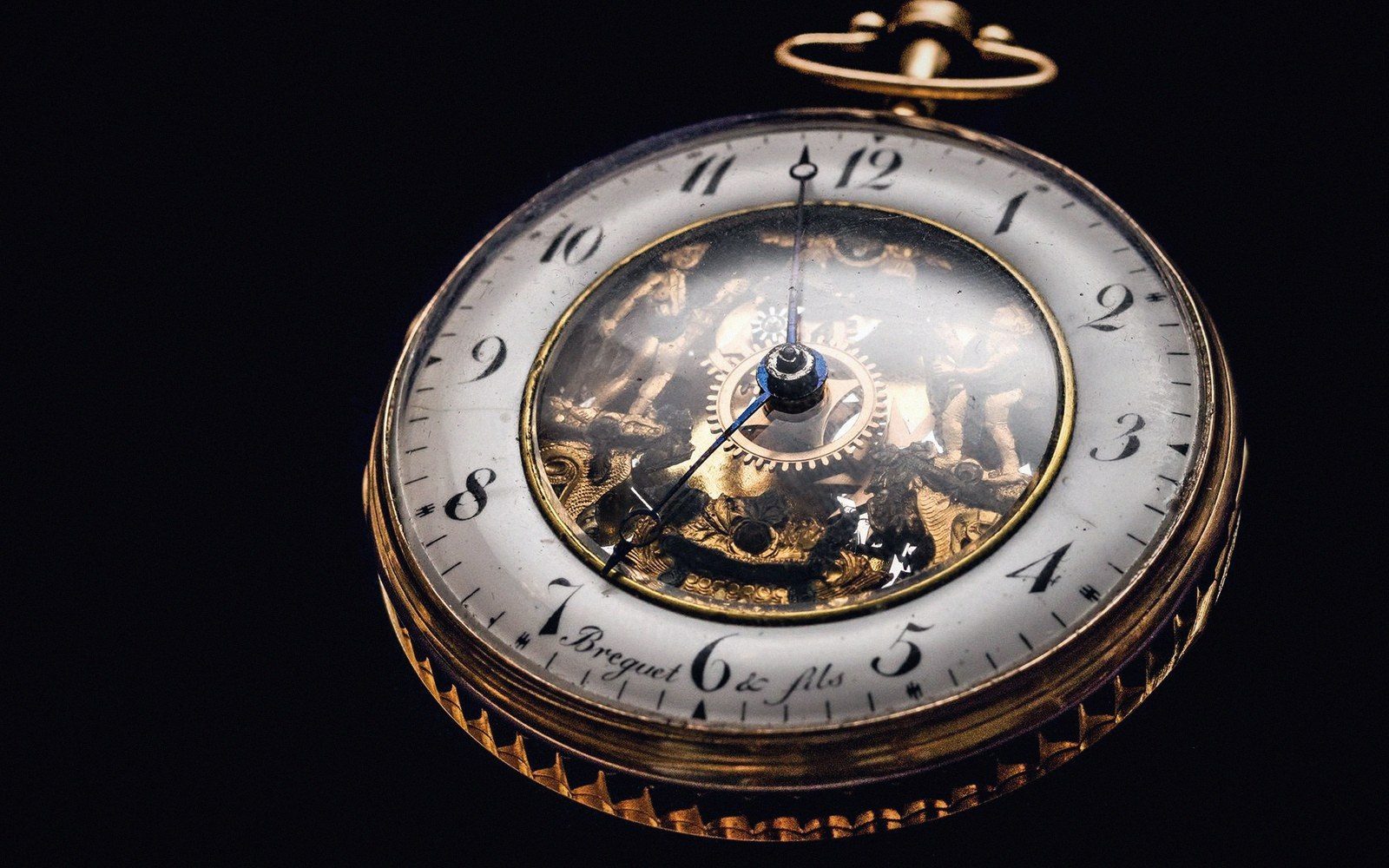
The escapement that started it all — and the one that corrupts its own oscillator most aggressively.
A Crown and Two Pallets
The verge is the oldest mechanical escapement we know of, present in European tower clocks from at least the late thirteenth century and still found in bracket and lantern clocks well into the eighteenth. Its operation is straightforward to picture. A crown wheel — a wheel with teeth projecting axially from its rim like a ring of pointed spikes — turns under the pressure of the going train. Engaging it is a vertical rod, the verge, carrying two small projections called pallets set roughly ninety degrees apart around its circumference. As the crown wheel turns, one tooth catches the upper pallet and pushes the verge to rotate; that rotation brings the lower pallet into the path of a tooth on the opposite side of the crown wheel, which arrests the train and pushes the verge back. Each half-swing unlocks one tooth. The wheel advances, the verge rocks, the wheel advances again.
Set the verge oscillating against a foliot — a horizontal bar with adjustable weights on its arms — and you have a clock. Replace the foliot with a balance wheel and you have a watch. Neither is isochronous in any meaningful sense; the foliot is simply a controllable inertia, not a restoring-force oscillator, and the balance without a hairspring has no natural period at all.
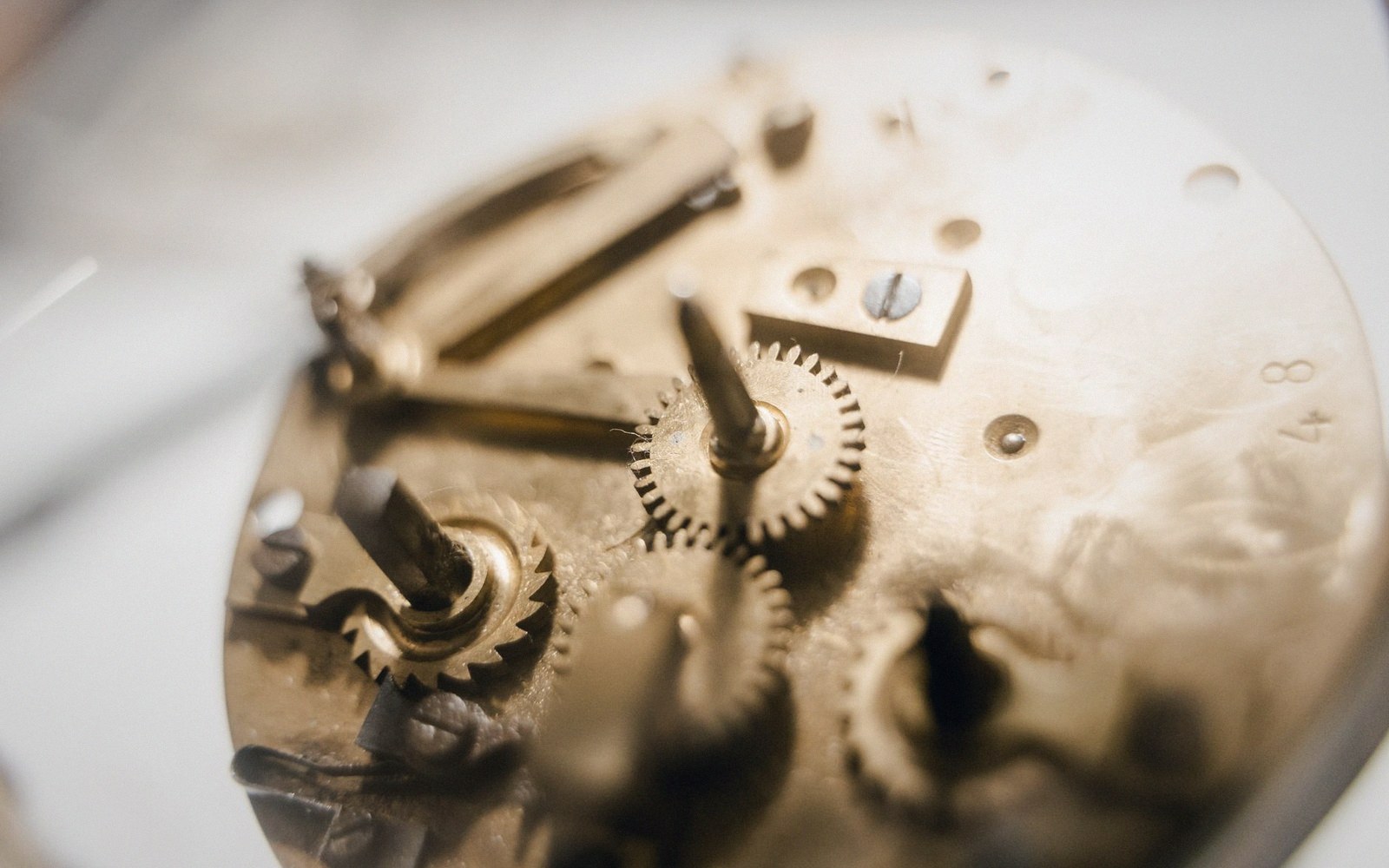
This is the verge's deep problem. Because the pallets are always in contact with the crown wheel, the train is pushing the oscillator throughout its swing. There is no detached phase, no moment when the oscillator swings free. Every impulse the escapement delivers also interferes: the crown wheel is either driving the verge or being driven back by it at every point of the cycle. The result is that the period is heavily dependent on how hard the mainspring is pushing. A freshly wound clock runs noticeably faster than one nearly run down.
Longer pendulums made this worse, not better. A verge clock demands a wide arc — often thirty degrees or more — which compounds circular error and makes the swing even more sensitive to drive force. When the anchor escapement arrived in the 1670s, the verge's days as a precision instrument were effectively over, though it survived in portable work for decades longer.
From the bench notes
How it works
- Crown wheela wheel with teeth pointing axially, like spokes on a ring
- Vergethe vertical rod the crown wheel drives
- Palletstwo projections on the verge, set ~90° apart, that alternately catch crown-wheel teeth
- Foliota plain inertia bar used before the pendulum; adjustable weights set the rate
- No detached phasepallets are always in contact; the train pushes the oscillator throughout the swing
From the bench notes