The Oscillator · Entry 06
The Balance and Its Spring
A pendulum you can carry: what replaces gravity, and why the spring's material matters more than the wheel.
Replacing Gravity With Metal
A pendulum clock works because gravity is constant. Suspend a weight at a fixed length and it returns to rest at the same rate every time — pitch-perfect, provided nothing changes. But gravity needs a fixed floor and a plumb vertical, both of which disappear the moment you put the clock in a pocket or on a moving ship. Something else has to supply the restoring force.
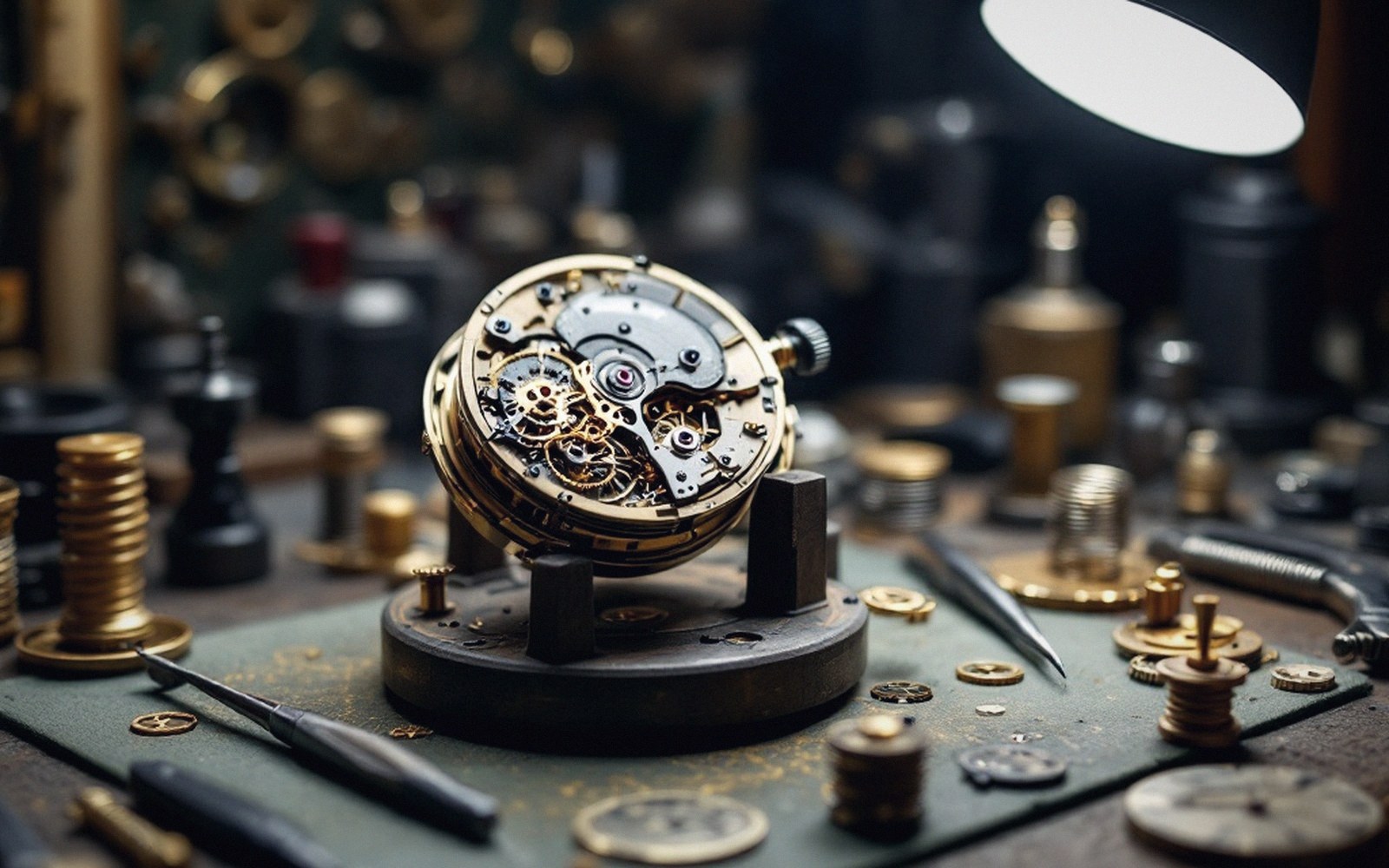
The balance wheel and its hairspring are that substitute. The wheel oscillates rotationally rather than swinging in an arc; the spring — a long, thin spiral of metal anchored at its outer end to the movement and at its inner end to the staff — provides the elastic restoring couple that returns the wheel to its rest position. Wind the spring by deflecting the wheel; it pushes back; the wheel overshoots the other way; repeat. The rate of that oscillation is set by the wheel's moment of inertia and the spring's stiffness: heavier rim, slower beat; stiffer spring, faster one. Neither parameter drifts with changing altitude the way a pendulum's rate drifts with changes in the strength of local gravity.
What does drift, severely, is the spring's elasticity with temperature. Blue steel — the traditional material — softens when warm and stiffens when cold. A steel hairspring in a pocket watch can lose several seconds per day as body heat varies throughout the day. This is the central material problem of the portable timekeeper, and it occupied makers for two centuries.
The partial mechanical answers — bimetallic compensation balances, with their cut rims of brass and steel curling inward in heat — worked tolerably for rough timekeeping but never cleanly. The real solution arrived when Charles-Édouard Guillaume, working at the Bureau International des Poids et Mesures in Sèvres, developed Elinvar, a nickel-iron-chromium alloy whose modulus of elasticity barely changes across the temperatures a watch experiences. Pair an Elinvar spring with an Invar balance and the thermal error collapses to something regulation can handle. Guillaume received the Nobel Prize in Physics in 1920 for this work.
Today most mechanical watches run springs of Nivarox, a further-refined alloy that adds beryllium and chromium, made non-magnetic in the process. The wheel and spring together form the oscillator; everything else in the movement exists to keep that oscillator running at its rated amplitude and to count its beats.
From the bench notes
The physics in numbers
| Quantity | What it means |
|---|---|
| Balance wheel rest position | the equilibrium point; spring torque is zero here |
| Restoring couple | the torque the hairspring exerts as it is deflected; increases roughly linearly with angle |
| Moment of inertia | the balance rim's mass distributed at radius; governs period alongside spring stiffness |
| Elinvar | Guillaume's alloy; constant (invariable) elasticity across working temperatures |
| Nivarox | mid-20th-century successor alloy; non-magnetic, low thermal coefficient, standard in modern mechanical watches |
From the bench notes
Chronology
- Pre-1896bimetallic compensation balances the standard compromise
- 1896Guillaume develops Invar at the BIPM, Sèvres
- 1920Nobel Prize in Physics awarded to Guillaume for his work on precision alloys
- Mid-20th centuryNivarox family of alloys enters widespread manufacture