The Train · Entry 03
Keeping It Going While You Wind It
The small mechanism that stops the clock stopping during winding.
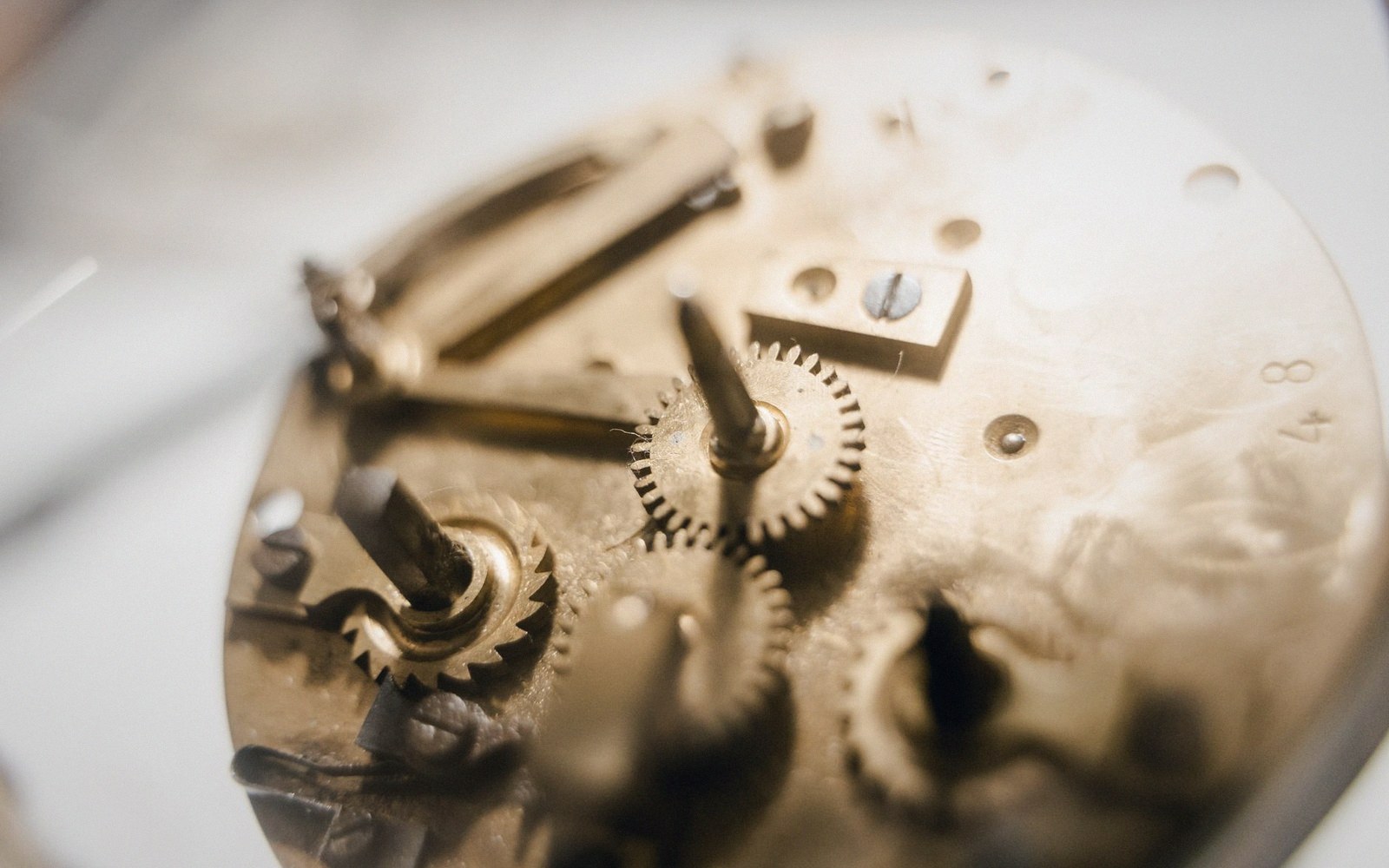
A mainspring loses tension the moment you start winding. Without a trick in the train, the clock stops.
The Problem at the Instant of Winding
When you insert a key and turn it, you are asking the mainspring to run backwards — or at least to surrender its grip on the going train while you add tension. In a simple movement with no provision for this, the answer is silence: the escapement stops, the pendulum or balance halts, and whatever time error accumulates during winding is yours to estimate and correct afterward. For a domestic bracket clock wound every day, that is a nuisance. For an observatory regulator or a precision timekeeper, it is intolerable.
The answer is the maintaining power — a secondary spring, modest in strength, that takes over the job of driving the train for long enough to complete the winding stroke. Its only duty is to keep the escapement ticking for perhaps thirty seconds; it need not keep accurate time, only continuous motion.

How It Works
The classic arrangement, refined for English fusee movements by the eighteenth century, sits between the winding square and the first wheel of the going train. A small detent, or click, normally holds a supplementary spring in a cocked position. The moment you engage the winding key, the act of turning it releases that spring, which then presses on the train and sustains drive. While you wind, the maintaining spring is doing the work; when you withdraw the key, the click re-engages and the fully tensioned mainspring resumes authority. Once the key is withdrawn and the click re-engages, the maintaining spring is cocked again, ready for the next winding.
The bolt-and-shutter variant, common on bracket and longcase clocks, makes this compulsory rather than optional. A shutter physically blocks the winding square until you first push a lever that simultaneously cocks the maintaining spring. You cannot wind without activating it. Negligence is designed out.
A different approach, found in some other clocks, is an independent winding arrangement: the clock is wound through a different path entirely, one that does not interrupt the main drive at all. Elegant, but it requires a more elaborate movement architecture.
From the bench notes
Key mechanisms
| Item | What it means |
|---|---|
| Maintaining power | secondary spring that drives the train during winding |
| Bolt-and-shutter | shutter blocks the winding square until the maintaining spring is cocked; makes correct winding procedure compulsory |
| Independent winding | routes the winding path away from the going train entirely, avoiding any interruption to the drive |
What all these solutions share is the same logic: keep the oscillator moving at all costs, because a stopped pendulum loses its place in time and has to be restarted from scratch.