After Mechanics · Entry 02
Quartz Has a Temperature Problem Too
The parabola, and how a compensated movement corrects for it.
Quartz crystal resonators drift with temperature — not linearly, but along a precise curve. Compensation is what turns a decent oscillator into a reliable one.
The Parabola in the Crystal
A tuning-fork quartz crystal cut at the standard 32,768 Hz geometry — the so-called 32 kHz watch crystal — has a frequency-temperature relationship that follows a smooth inverted parabola. It runs fastest at roughly 25 °C and loses rate symmetrically on either side of that peak. The drift is small but measurable: across the range a wristwatch sees in daily wear, perhaps −0.035 parts per million per degree squared away from the turnover point. That sounds negligible; across a year it is not.
The cut of the crystal determines where the parabola's apex sits and how steep its sides are. An AT-cut crystal, used in higher-frequency oscillators, is engineered so that its turnover temperature falls conveniently near room temperature and the curve is flatter, but watch-grade tuning-fork cuts are cheaper to produce and power-efficient enough to run for years on a single cell — at the cost of a steeper, more consequential curve.
Correcting the Curve
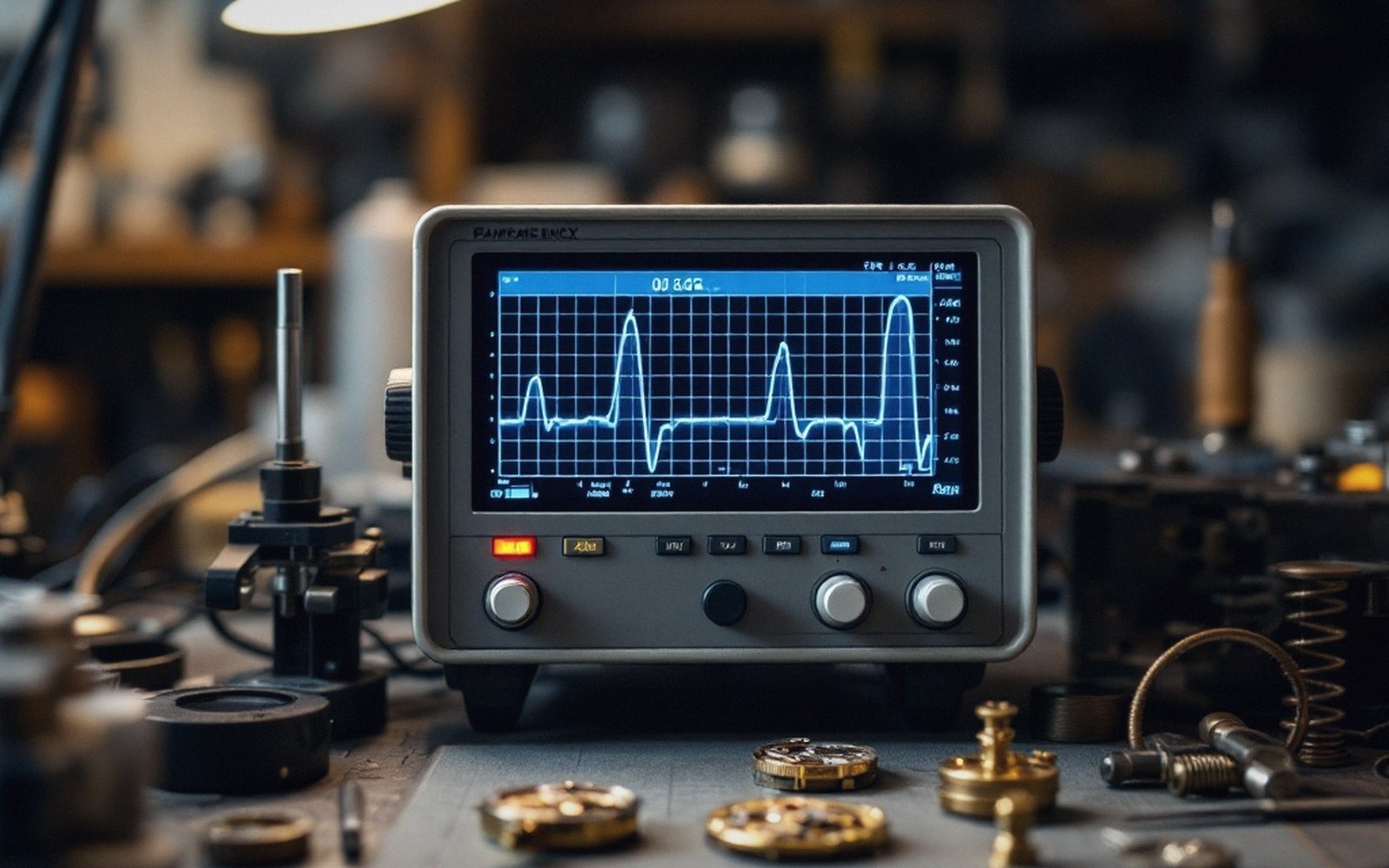
A temperature-compensated quartz oscillator — a TCXO — measures the crystal's temperature continuously, usually with a thermistor, and applies a correction to the signal before it reaches the counting circuit. The correction is the mathematical inverse of the parabola: where the crystal would run fast, the circuit trims it back; where it would run slow, it trims forward. A well-implemented TCXO holds rate to within a second or two per year. A plain, uncompensated watch crystal might drift several seconds a month.
The more demanding solution is the oven-controlled oscillator, the OCXO, in which the crystal is held at a fixed elevated temperature — typically at or above the turnover point — by a small thermostatted heater. Remove the temperature variation entirely and the frequency-temperature curve becomes irrelevant. OCXOs achieve stabilities measured in parts per billion, but they consume power continuously to maintain the oven, which is why they appear in laboratory instruments and telecommunications infrastructure rather than wristwatches.
Temperature compensation is, in this sense, the same engineering problem that confronted pendulum makers: a resonator's rate changes with temperature, and precision demands either a material that resists the change or a mechanism that corrects for it. The gridiron and mercury pendulum answered the pendulum maker's version; the TCXO answers the crystal's. The physics differs; the discipline is identical.
From the bench notes
The frequency-temperature curve
| Item | What it means |
|---|---|
| Turnover temperature | the temperature at which a tuning-fork quartz crystal reaches peak frequency, typically near 25 °C for standard watch cuts |
| Parabolic drift | frequency falls away from the turnover point on both sides, following a squared relationship with temperature offset |
| AT-cut vs. tuning-fork cut | AT-cut crystals use a different slice angle through the quartz blank, giving a flatter, higher-frequency curve suited to oscillators where power draw is less critical |
From the bench notes
Key distinctions
| Item | What it means |
|---|---|
| TCXO (temperature-compensated crystal oscillator) | corrects the output signal electronically using a thermistor-derived temperature reading; compact, low power |
| OCXO (oven-controlled crystal oscillator) | eliminates temperature variation by heating the crystal to a fixed point; far more stable, far more power-hungry |