After Mechanics · Entry 01
A Crystal That Counts
A quartz oscillator runs at tens of thousands of cycles per second and costs almost nothing, which ended the argument commercially even where mechanics survived culturally.
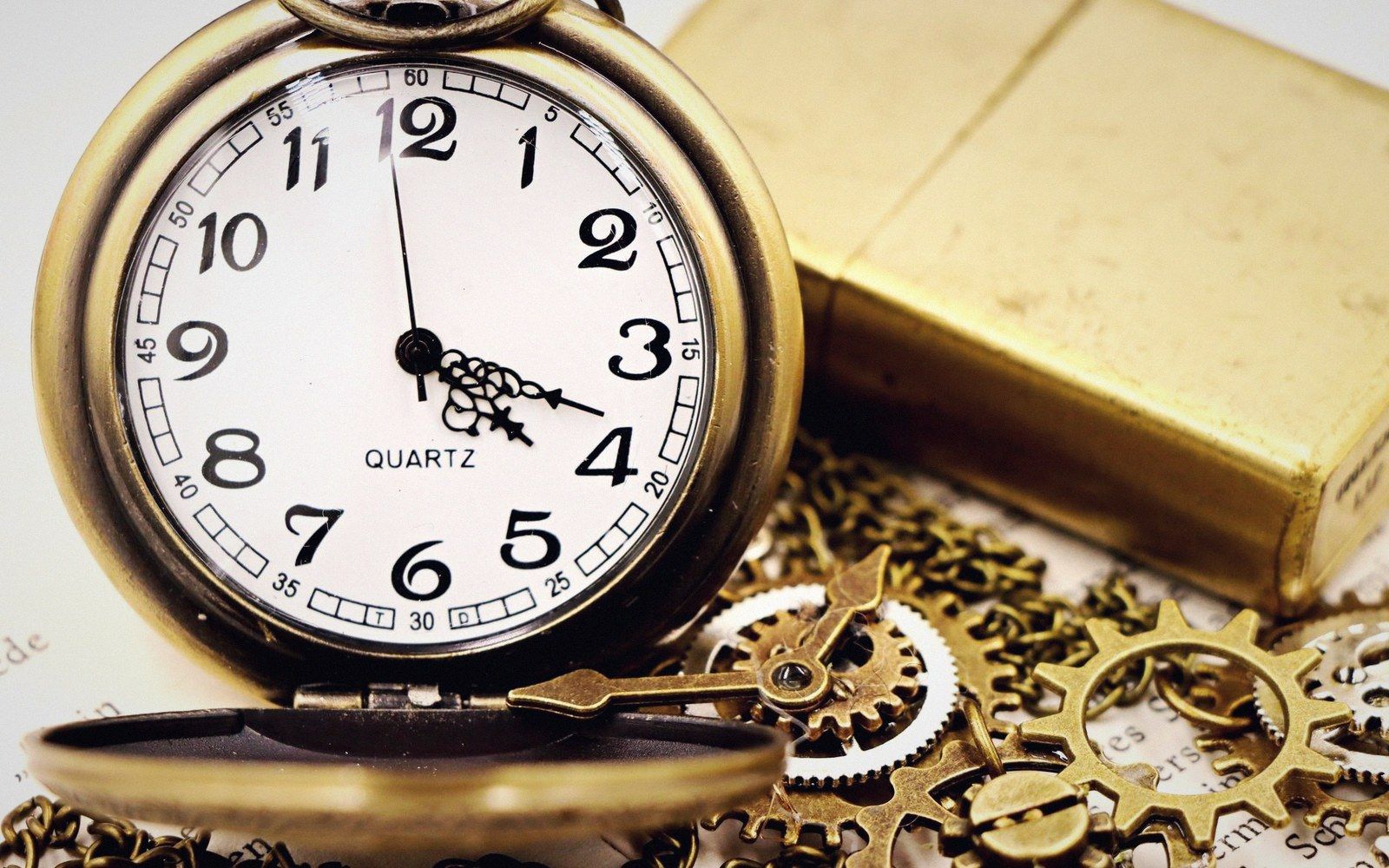
Cut from stone to circuit: the oscillator that made mechanical timekeeping commercially obsolete overnight.
How Quartz Became a Clock
Quartz is piezoelectric: apply a voltage across a slice of the crystal and it flexes; flex it and it generates a voltage. Feed that voltage back into the circuit and the crystal sustains its own oscillation at a frequency set almost entirely by its physical dimensions. A tuning-fork–shaped quartz blank ground to the right geometry vibrates at 32,768 Hz — written as 2¹⁵, chosen precisely so that fifteen stages of binary division produce one pulse per second. That single pulse drives a stepper motor to move hands, or clocks digital digits, or both. The arithmetic is clean; the physics is cleaner still.
Thirty-two thousand oscillations per second against a pendulum's one or two is not merely faster — it changes the nature of the error. A pendulum's rate is sensitive to temperature, to the amplitude of its swing, to the density of the air around it. A quartz oscillator is sensitive to temperature too, but in a well-characterised, predictable way: its frequency follows a smooth parabolic curve with a peak near room temperature, which a simple compensation circuit can correct for. Where pendulum makers spent two centuries engineering gridirons, mercury-filled cylinders and exotic alloys to fight thermal expansion, quartz engineers solved the same problem with a thermistor and a trimmer capacitor. The engineering moved from metal to silicon, and shrank accordingly.
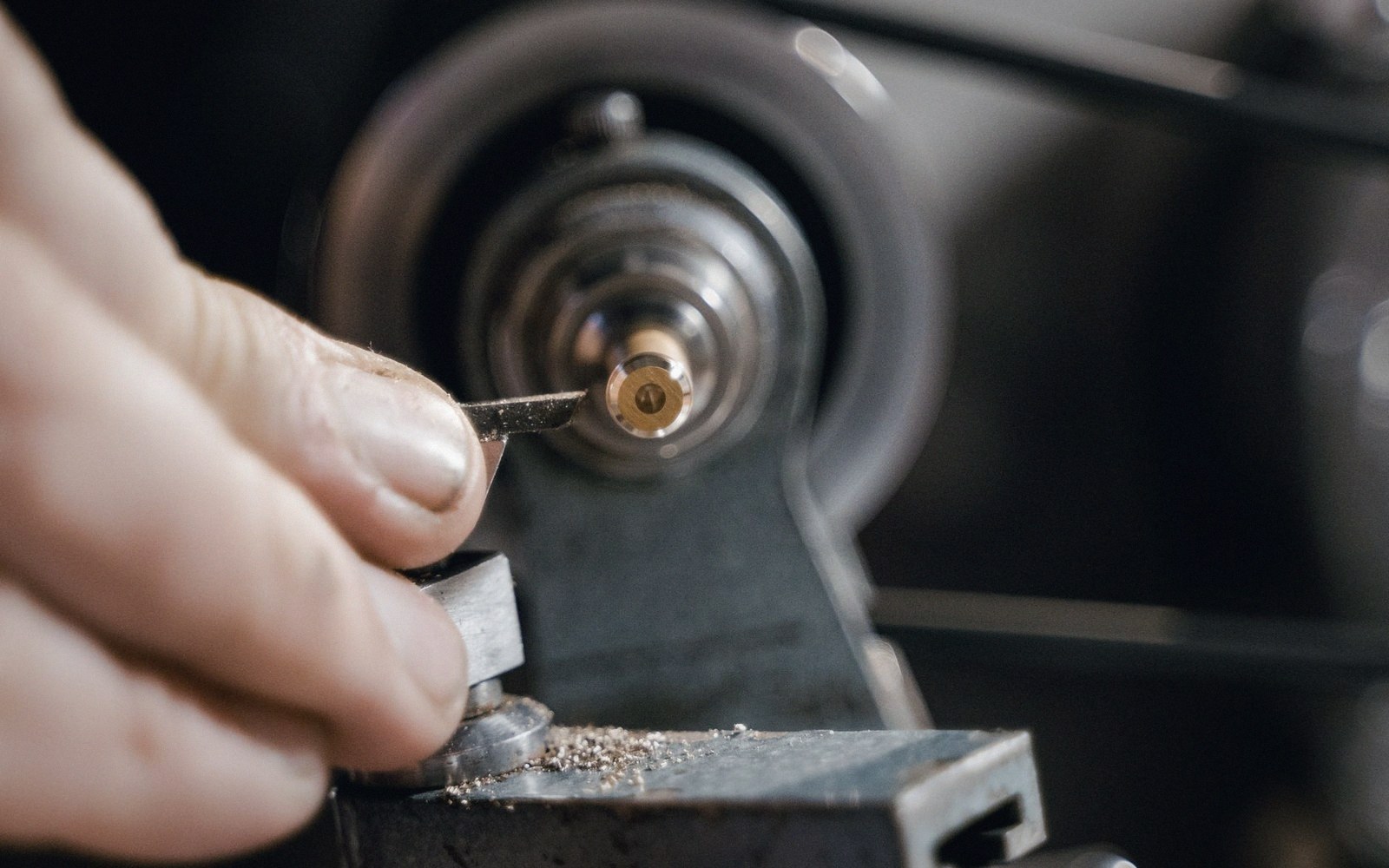
Accuracy for Almost Nothing
The practical reckoning is blunt. A cheap quartz wristwatch of the sort that flooded the market from the mid-1970s onward loses or gains a few seconds a month — better than most mechanical watches costing many times more, and requiring no service for years. A temperature-compensated quartz oscillator (TCXO) does better still, holding rate to within a second or two per year without exotic components. An oven-controlled version (OCXO), which keeps the crystal at a constant elevated temperature, can achieve stabilities that mechanical horology never approached.
The commercial consequences were severe and fast. Swiss manufacturers, who had built their entire industry on mechanical precision, found that precision was no longer a distinguishing argument. The so-called quartz crisis of the 1970s was not a slow decline; it was a compression. Factories that had made lever escapements and balance wheels for a century closed within a decade. Japan — Seiko having introduced the first quartz wristwatch, the Astron, in December 1969 — and later Hong Kong became the volume producers. The movement that resulted was not just cheaper; it was categorically simpler to manufacture, needing no skilled hand-adjustment of hairsprings or pallet stones.
What the oscillator cannot do, on its own, is set itself. The crystal counts with extraordinary consistency, but it counts from whatever starting point it is given and drifts, slowly, from the true time. The solution to that — radio and network synchronisation, a clock that checks its count against an external standard — is a further step. The quartz oscillator provides the short-term stability; the external reference corrects the long-term drift. Neither is sufficient alone, and the two together describe nearly every clock that surrounds a person today.
From the bench notes
Key numbers
| Quantity | What it means |
|---|---|
| 32,768 Hz | standard quartz tuning-fork frequency; equals 2¹⁵, allowing clean binary division to 1 Hz |
| December 1969 | Seiko Astron introduced; first commercial quartz wristwatch |
| A few seconds per month | typical accuracy of a consumer quartz watch |
| Seconds per year | typical accuracy of a TCXO (temperature-compensated oscillator) |
Mechanical watchmaking survived, but the argument that sustained it for four centuries — that a well-made mechanical movement kept better time than any practical alternative — expired in December 1969 along with the Astron's first sale. What replaced it was a different argument entirely: that the mechanism itself, independent of its timekeeping performance, was a thing worth making and wearing. That is a cultural claim, not a technical one, and the quartz crystal had nothing to say about it.
From the bench notes
How the technology stacks up
| Item | What it means |
|---|---|
| Bare quartz oscillator | seconds per month drift |
| TCXO (temperature-compensated) | seconds per year |
| OCXO (oven-controlled) | sub-second per year, without atomic reference |
| Caesium atomic standard | defines the second itself |