After Mechanics · Entry 05
Why Mechanical Survived Anyway
Once accuracy stopped being the argument, what was left as the reason to make them.
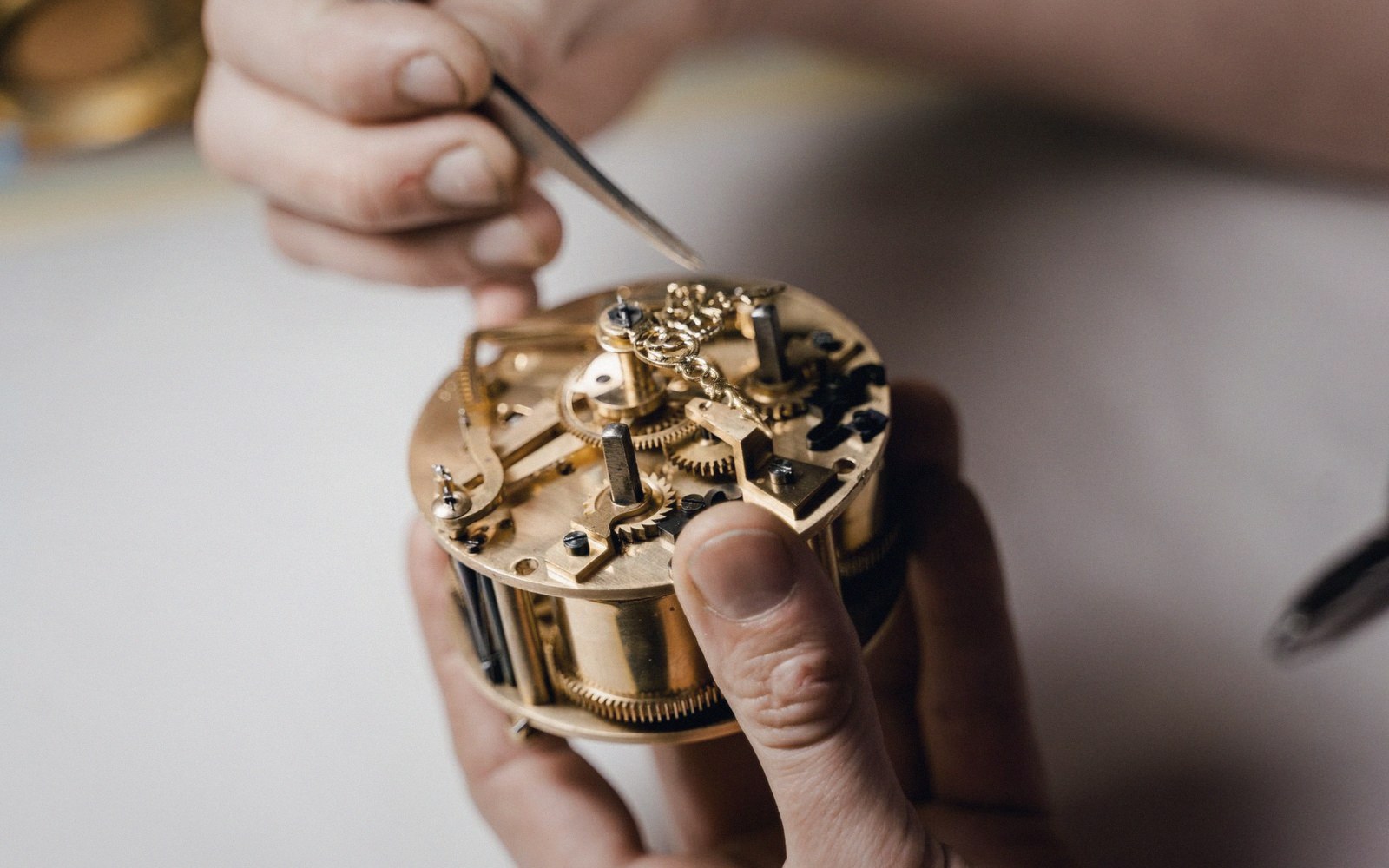
Once quartz made accuracy a solved problem, the mechanical clock had to find a different reason to exist. It found several.
What Accuracy Stopped Proving
A cheap quartz movement from the 1970s would embarrass the finest marine chronometer of the 1870s. That fact settled the accuracy argument permanently. The escapement, the compensation pendulum, the fussed-over hairspring — none of it could compete with a crystal vibrating at 32,768 cycles per second for a few pence of electricity. If timekeeping were only about rate, the mechanical movement would have become a museum object.
It didn't, and the reason is that accuracy was never the only thing a finely made movement was doing.

The Legible Machine
What survived was the mechanism as object. Open a quality movement and every part of the going train is traceable by eye: the mainspring's coiled tension, the gear ratios counting oscillations into minutes, the escapement releasing one tooth at a time. Nothing is hidden in a sealed oscillator or dissolved into firmware. The whole causal chain from stored energy to moving hand is right there, visible and touchable, operating on principles that require no specialist faith to grasp.
That legibility turns out to be genuinely valued. A quartz watch tells you the time. A mechanical one also tells you — continuously, if you choose to look — exactly how it tells you the time. The distinction is not sentimental; it is structural. One is a readout; the other is a demonstration.
Craft entered the argument at the same moment. The tolerances inside a well-made lever escapement, the surface finish on a polished pivot, the geometry of a properly adjusted pallet — these are skills with no quartz equivalent. They can be admired, and they can be accumulated as evidence of work done by hand at a level that mass production cannot fake.
From the bench notes
What changed the terms
| Term | What it means |
|---|---|
| Quartz accuracy breakthrough | c. 1970s, when off-the-shelf quartz movements surpassed precision mechanical clocks on rate |
| 32,768 Hz | the oscillation frequency of a standard quartz tuning-fork crystal; chosen because it is 2¹⁵, allowing division to 1 Hz by binary logic |
Longevity completed the case. A mechanical movement, properly maintained, is not consumed. The same train can run for generations. No battery chemistry to degrade, no firmware to orphan, no manufacturer support window to expire. In a culture increasingly aware of what disposability costs, a mechanism that outlasts its owner reads differently than it once did.
None of this is nostalgia dressed up as reason. It is a genuine shift in what the object is for.
From the bench notes
What the mechanical movement is now doing
| Item | What it means |
|---|---|
| Legibility | entire going train causally visible and traceable without instruments |
| Craft evidence | polished pivots, escapement geometry, hand-fit tolerances; nothing a quartz module can demonstrate |
| Longevity argument | no battery, no firmware, no planned obsolescence; a well-maintained movement outlasts its owner |