Escapements · Entry 06
The Detent
The most accurate mechanical escapement and the least practical to wear — why marine chronometers used it.
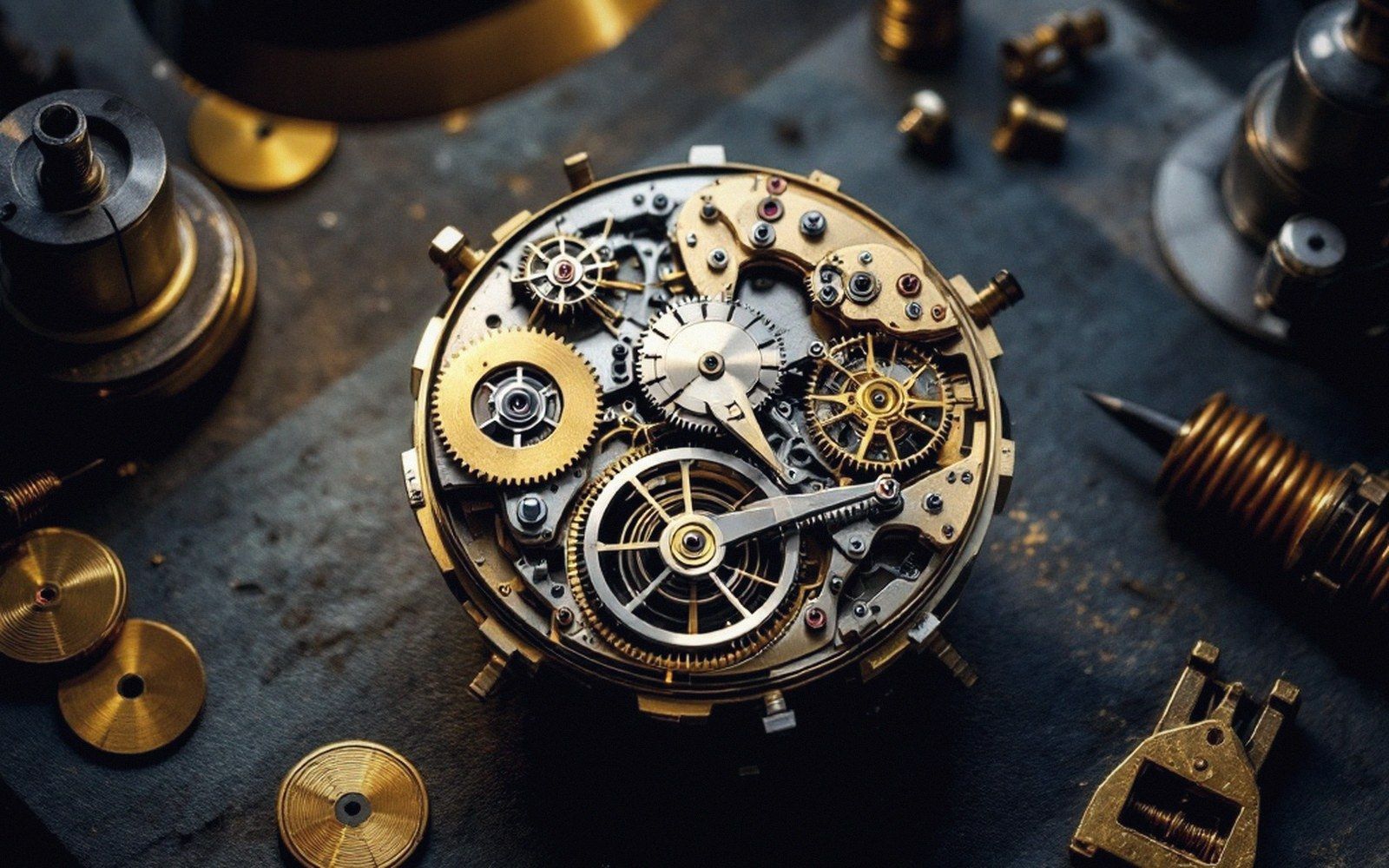
Free for nearly the whole beat, locked by a hair-trigger: the escapement that made ocean navigation possible.
The Most Honest Escapement Ever Built
Every mechanical escapement makes a trade-off between controlling the oscillator and leaving it alone. The verge barely lets go at all; the lever releases its balance cleanly but nudges it twice per vibration to stay in step. The detent — the escapement fitted to every serious marine chronometer from the late eighteenth century onward — goes furthest of any toward leaving the oscillator entirely to itself.
The mechanism is almost shockingly simple. A single spring-blade, the detent, holds a tooth of the escape wheel. Once per full oscillation, the balance roller carries a ruby impulse pallet that sweeps the wheel forward by one tooth, giving the balance its push, and a tiny passing spring deflects the detent out of the way on the return swing without engaging the wheel at all. That is the whole story: one impulse per full rotation of the balance, one point of contact, and an unlocking action so light it barely disturbs the oscillation at all.
Compare that with the lever, where the balance receives two impulses per rotation and is positively engaged by fork and guard pin throughout. The lever's interference is the price of its resilience; the detent's freedom is the source of its precision. A chronometer movement with a well-made detent escapement can achieve a rate stability that a lever-escapement watch cannot approach, not because the lever is badly designed but because any extra contact costs accuracy.
The liability is exactly that lightness. Knock a chronometer hard enough and the passing spring can be thrown back, allowing the detent to unlock at the wrong moment — a phenomenon called "setting," which stops or wildly disrupts the movement. Aboard a sailing ship this is a real risk; aboard a ship being navigated with care, and the chronometer mounted in gimballed boxes on a cushioned shelf, it is a manageable one. On a wrist, where violent shocks are constant, the detent is simply unworkable. The lever's positive engagement, which costs it so much in isochronal purity, is exactly what keeps it running after a stumble.
John Arnold and Thomas Earnshaw both refined the detent into its mature form in the 1780s, and their designs — the pivoted detent and the spring detent respectively — competed directly. Earnshaw's spring detent won in practice: simpler, lighter, easier to make consistently, and robust enough for shipboard use. It remained the standard for marine chronometers well into the twentieth century, outlasting the navigational need that created it.
From the bench notes
Key mechanism parts
| Part | What it does |
|---|---|
| detent | the spring-blade that locks the escape wheel; the escapement is named for it |
| passing spring | the delicate secondary spring that deflects the detent on the return swing without unlocking the wheel |
| impulse pallet | the ruby on the balance roller that sweeps the escape wheel forward |
| setting | the failure mode where shock throws the detent back and disrupts the motion |
The detent is the answer to a question that only precision asks: what happens if you trust the oscillator completely and simply get out of its way?

From the bench notes
Two makers, one winner
| Item | What it means |
|---|---|
| John Arnold | pioneered the pivoted detent form in the 1780s |
| Thomas Earnshaw | developed the spring detent; simpler, more consistent in production, became the standard fitting in marine chronometers |